
Prime Big Deal Days falls on October 6 and 7 this year [1]. For two days, millions of shoppers ask Alexa for Shopping what to buy, and it answers from whatever is in your listing at that moment.
That agent isn't a novelty anymore. Amazon reported that more than 350 million customers used Alexa for Shopping, the agent that replaced Rufus, in the last 12 months, with interactions up more than 5x year over year [2]. It already buys on its own when a product hits the price the customer set [3]. At Walmart, customers who shop with Sparky spend 40% more per order than those who don't [4].
Outside the marketplaces, the same thing is happening. In late September, NielsenIQ reported that 51% of US consumers used at least one AI tool to shop in the past month, the first time the number has passed the halfway mark [5]. Adobe measured a 393% year-over-year jump in AI-referred traffic to US retail sites in the first quarter of 2026. In March, that traffic converted 42% better than non-AI traffic and produced 37% more revenue per visit [6].
In my view, these numbers together are still being read as far too small. It's not that one more channel showed up. It's that new filters have moved in between your product and the person who's going to buy it. Today there are four.
Four filters between your product and the buyer
- •AI assistants. ChatGPT, Gemini, Claude, Perplexity. When someone asks what to buy, they build a product card out of whatever they can find about you: title, price, attributes, reviews, store. If the data isn't there, the card ships without it. Or it ships with your competitor.
- •Marketplace agents. Alexa for Shopping on Amazon, Sparky at Walmart. This is the most mature filter: it has the cart, the order history, the shipping promise and, on Amazon, it already completes the purchase without a click [3]. It reads what's in the listing: title, bullets, product attributes, Q&A, reviews. Only what's in the listing.
- •Personal agents. General-purpose assistants that browse sites, compare, and are starting to close the purchase on the consumer's behalf. In September, Meta launched Muse in the US, an agent that opens a browser, fills out forms and completes the checkout, and that you talk to in its own app or directly in WhatsApp [11]. Amazon already does something similar on third-party sites with Buy for Me [3], and Google launched UCP, an open protocol for agents to buy from any store, now powering checkout with Google Pay from Search and Gemini [7] [8]. It's the least mature layer, but the one that changes the consumer's relationship with buying the most: they delegate the whole task.
- •Your own site's search and assistant. LLM-powered search, recommendations, support that sells. It reads your catalog straight from the source, with every defect the source has.
| Filter | Where it decides | What it reads from your catalog |
|---|---|---|
| AI assistants | In the answer, before any store | Feed, product page, spec sheet, reviews, consistency across sources |
| Marketplace agents | Inside Amazon and Walmart | Title, bullets, backend attributes, images, Q&A, reviews, channel rules |
| Personal agents | On the site where the purchase closes | Machine-readable page, price, stock, purchase terms |
| Your own site | In your store | Rich attributes for semantic search and recommendation |
Four filters, with different owners and different levels of maturity. What they have in common is what matters.
None of them is impressed by a nice photo
In the first piece I wrote on this blog, I argued that agentic commerce changes the logic of eligibility in e-commerce [9]. When a person lands on your listing, you can still persuade. When an agent evaluates your product, you first need to be understood.
That's how all four filters work. They read attributes, spec sheets, titles, images, and consistency across channels. An empty field is already a reason to skip you. A dimension that says one thing on Amazon and another on your site is a reason to distrust you.
| What convinces a person | What an agent reads |
|---|---|
| A nice photo | An image that matches the spec sheet |
| Clever copy | Attributes filled in and standardized |
| A catchy title | A title that answers what the buyer asked |
| A well-designed page | The same data on every channel |
| A prominent promotion | Price, stock and condition in machine-readable form |
Think about what happens when the bullets on your Amazon listing say the backpack fits a 15.6-inch laptop, the backend attribute says 14 inches, and your own site says 15. The agent has two paths. It can distrust you and recommend the competitor. Or it can recommend you and hand the customer something different from what it promised. In the first case, you vanish from the answer. In the second, you get a return.
Either way, the problem isn't media. It isn't ranking. It's consistency.
That's exactly what we see at GLOBALD. Across the more than 500,000 SKUs our compliance agent has analyzed, the most frequent errors aren't about persuasion. They're about consistency: dimensions that differ between image and text, colors that don't match, product names that change from one place to another, language errors, channel rule violations.
None of these problems takes your brand out of the conversation. All of them can take your product out of the purchase.
The strongest filter is inside the marketplace
There's a common reading that AI is going to pull product search out of Amazon. I don't think that's quite it.
In the US, 57% of consumers start their product search on Amazon, against 42% on search engines [10]. That hasn't changed. AI-referred traffic is growing fast, but even after a 393% jump it's still a small slice of total retail visits.
What changes isn't where the customer searches. It's what answers the search. Instead of a results page sorted by rank and sponsored placements, an agent that reads the listing, compares attributes, and picks. Alexa for Shopping doesn't look at your main image the way a shopper does. It reads the title, the bullets, the product attributes, the Q&A, and the reviews, and it answers the shopper's question from that. If the bullets say one thing and the attributes say another, it has to decide which one to believe. Amazon already does this with 350 million customers. Walmart's Sparky user base grew 70% in a year [4].
Prime Big Deal Days is the first live test of the season. Whatever the agent reads during those two days is what you shipped the week before.
For sellers, this means your product now gets filtered twice. By the agent outside, which decides whether you make it into the answer. And by the agent inside, which decides among the listings that survived. Both read the same thing.
The good part: the base is the same for all four
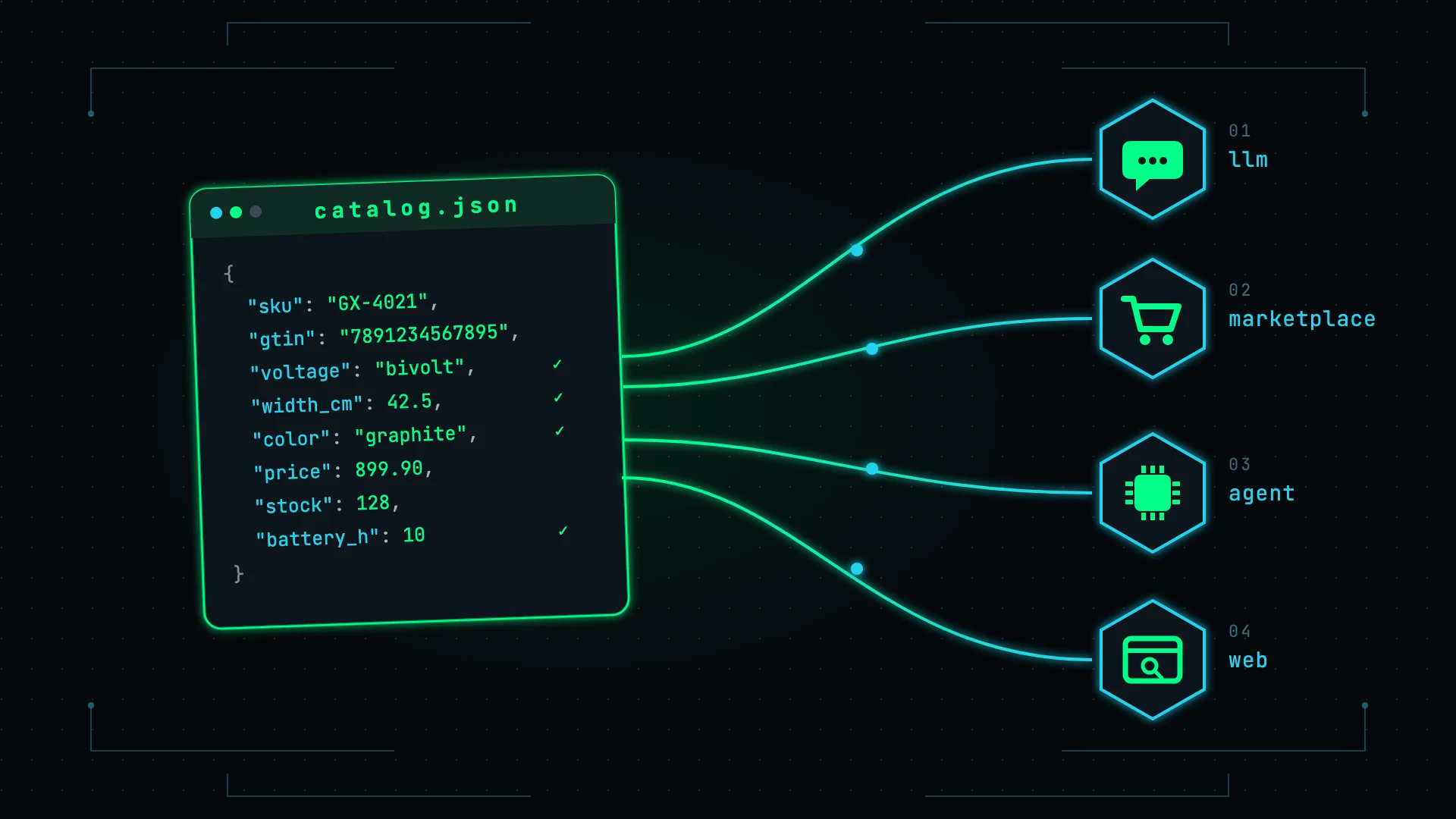
What the four filters require at the base is identical: attributes that are complete, correct, and consistent with each other. That work is done once, at the source.
The output isn't. Each filter reads the product in its own format. Amazon has its own attribute schema and title rules. Walmart Marketplace has its own spec. AI assistants read feeds and structured data on the page. UCP has its standard. Your site has its schema. The same product has to be translated for each one.
The difference between having the base and not having it is what happens in that translation. Without the base, every channel becomes a rewrite, and every rewrite carries a different error. That's how the laptop size ends up different in the bullet, in the backend attribute, and on your site. With the base, translation becomes mapping: an attribute fixed at the source comes out right in the ChatGPT card, the Amazon listing, the personal agent's purchase, and your site's search.
That doesn't mean it's little work. Fixing a few dozen products is simple. Keeping thousands of SKUs consistent, in more than one language, translated for channels with different rules, and updated every week, is not. That's why this layer rarely gets solved with a spreadsheet and good intentions. It needs to become infrastructure: one source of truth and several outputs, each in the channel's format.
The catalog, long treated as back office, has become the interface between your product and the agents that decide on its behalf.
Where to start before Black Friday
Prime Big Deal Days is the dress rehearsal. Black Friday is November 27 and Cyber Monday is November 30. Less than eight weeks out, there's time to do the essentials:
- •Ask the agents before your customer does. ChatGPT, Gemini, and Alexa for Shopping. Ask the questions a buyer in your category would ask, with a real need and a real budget. See whether your product makes the list, with what information, and where the link goes.
- •Compare what the agent says with what the listing says. Every discrepancy in dimensions, capacity, color, or compatibility between bullets, backend attributes, and your own site is a lost sale or a return waiting to happen.
- •Keep a source of truth outside the marketplace. The listing can't be the only place your product is well described. The same data needs to feed Amazon, Walmart, your own site, and the feeds the AIs read.
- •Write attributes that answer questions. The agent decides on what the buyer asked. If they want battery life and your listing doesn't say, you're not in the conversation.
- •Start with what sells most. You can't fix everything by November. You can fix what weighs most.
The catalog the agents will read
For years, the question sellers asked was: does my page convert?
It's still valid. But with four agents in the way, the first question has become a different one:
When an agent, inside or outside the marketplace, tries to sell my product, will it find what it needs to pick it?
If the answer is no, no amount of media or ranking investment fixes it. The agent has already picked someone else.
At GLOBALD, this is exactly the kind of problem that interests us: making the product understood by every agent that decides on its behalf. We audit the catalog, find the compliance, attribute, text, and image errors that keep the product out of the answers, fix them, and distribute the data, in each channel's format, to marketplaces, your own site, LLMs, and agent protocols like UCP.
Black Friday is November 27. The catalog the agents will read that day is whatever is live over the next few weeks.
References
- Prime Big Deal Days 2026 is set for October 6-7, About Amazon
- Q2 earnings: CEO Andy Jassy on Amazon Stores growth, delivery speed, and AI shopping, About Amazon (Jul 31, 2026)
- Amazon's next-gen AI assistant for shopping, About Amazon
- Walmart says its AI assistant, Sparky, is leading to customers spending 40% more, Yahoo Finance
- Majority of U.S. Consumers Now Use AI to Shop, NIQ Finds, NielsenIQ (Sep 24, 2026)
- AI traffic to US retailers rose 393% in Q1, and it's boosting their revenue too, TechCrunch, on Adobe Analytics data (Apr 16, 2026)
- New tech and tools for retailers to succeed in an agentic shopping era, Google (UCP launch, Jan 11, 2026)
- How we're helping retailers thrive with new Universal Commerce Protocol features, Google (Universal Cart)
- E-commerce Isn't Gaining a New Channel. It's Gaining a New Buyer., Pedro Trevisan, GLOBALD
- Most US online shoppers start product searches on Amazon, eMarketer, on Jungle Scout data (2023)
- Introducing Muse: The World's First Personal AI Agent Built for Everyone, Meta (9/8/2026)
Frequently Asked Questions
Common questions about agentic commerce, product data optimization, and catalog structuring for AI agents.
What is agentic commerce?
Agentic commerce is the model of digital commerce in which autonomous AI agents research, compare, and increasingly purchase products on behalf of consumers. Instead of browsing pages and search results, the agent reads product data, such as attributes, price, availability, and reviews, and decides based on it.
What are the four filters a product passes through before reaching the consumer?
Four kinds of agents: (1) AI assistants such as ChatGPT, Gemini, and Claude, which build the product card from what they find about the brand; (2) marketplace agents such as Alexa for Shopping on Amazon and Sparky at Walmart; (3) personal agents such as Meta's Muse, which browse, compare, and are starting to buy on the consumer's behalf; and (4) the search and assistant on the brand's own site. All of them decide on catalog data, not photos or copy.
How many consumers already use AI to shop?
In the US, 51% of consumers used at least one AI tool to support shopping in the past month, according to NielsenIQ (September 2026). It's the first time the figure has passed the halfway mark. Amazon reports more than 350 million customers using Alexa for Shopping in 12 months, and Walmart says customers who shop with Sparky spend 40% more per order.
How much AI traffic are US retailers getting, and does it convert?
According to Adobe Analytics, AI-referred traffic to US retail sites grew 393% year over year in the first quarter of 2026. In March 2026 that traffic converted 42% better than non-AI traffic and generated 37% more revenue per visit, with visitors staying 48% longer on site. It's still a small share of total visits, but it's the fastest-growing one and it buys.
What is Amazon's Alexa for Shopping?
Alexa for Shopping is Amazon's AI shopping assistant, the name Rufus took on in May 2026. It searches products conversationally, compares options, shows price history, and buys automatically when a product reaches the target price the customer set (Auto-Buy). It answers from the listing itself: title, bullets, product attributes, Q&A, and reviews. According to Amazon, more than 350 million customers used it in the 12 months to July 2026, with interactions up more than 5x in a year.
Is AI going to take product search away from Amazon?
Not in the short term. 57% of US consumers start their product search on Amazon, against 42% on search engines. What changes is what answers the search: instead of a results page sorted by ranking, an agent that reads the listing, compares attributes, and picks. That agent already exists inside Amazon and Walmart, and it reads only what's in the listing.
Why aren't a nice photo and clever copy enough for AI agents?
Because agents aren't impressed by visual persuasion. They read attributes, spec sheets, titles, images, and consistency across channels. An empty field, or a dimension that differs between Amazon and your own site, gives the agent a reason to recommend a competitor or causes a return. Across the more than 500,000 SKUs GLOBALD has analyzed, the most common errors are consistency errors: dimensions and colors that differ between image and text, inconsistent names, language errors, and channel rule violations.
Is structuring the catalog the same work for every channel?
The base is. Complete, correct, and consistent attributes serve all four filters: AI assistants, marketplace agents, personal agents, and your own site. The output isn't. Each channel reads the product in its own format, with different schemas, fields, and rules: Amazon's attributes and title rules, Walmart Marketplace's spec, feeds and structured data for AI assistants, the UCP standard, your site's schema. With the base in place, that adaptation becomes a mapping from a single source. Without it, it becomes a rewrite per channel, and every rewrite carries a different error.
What should I fix in my catalog before Black Friday 2026?
With Black Friday on November 27 and Cyber Monday on November 30, 2026, the priorities are: ask the agents (ChatGPT, Gemini, Alexa for Shopping) about products in your category; compare what the agent says with what the listing shows; keep a single source of product data outside the marketplace; fill in the attributes that answer buyers' real questions; and start with your highest-revenue categories. The catalog the agents read on Black Friday is whatever is live in the weeks before.
How does GLOBALD help brands in agentic commerce?
GLOBALD is an AI-powered catalog data infrastructure that works as the system of record and system of action for the product. The platform audits the catalog, finds compliance, attribute, text, and image errors, fixes them, and distributes the data, in each channel's format, to marketplaces such as Amazon and Mercado Libre, your own site, LLMs, and agent protocols like UCP, with continuous learning on real data. More than 500,000 SKUs analyzed. GLOBALD serves brands in Brazil, Mexico, and the US, in Portuguese, English, and Spanish.
Ready to Prepare Your Catalog for Agentic Commerce?
Let GLOBALD audit your product data and create a roadmap for visibility in the age of AI agents.
Schedule a Free Audit