
Shopify now generates an llms.txt for every store. Wix generates one and keeps it updated automatically. Yoast SEO and Rank Math added it as a native feature in 2025.
The file became a default before it became a decision.
In May 2026, Ahrefs measured every request made to /llms.txt across 137,210 domains. Of those that had published the file, 97% received no requests at all that month. Not from a bot, not from a human [1].
Slackbot — which only fetches links to generate chat previews — accessed more llms.txt files than PerplexityBot.
And I still recommend that you write yours.
It's not a contradiction. llms.txt was sold for the wrong job. As a search visibility lever, it doesn't work, and there's already enough evidence to settle that debate. As discovery infrastructure for agents, it's a different conversation. And in e-commerce specifically, the platforms have already decided for you.
This article covers both: why the original promise is false, and how to write a file that's actually good for something.
What llms.txt Is (and What It Isn't)
llms.txt is a Markdown file at the root of your domain — yourstore.com/llms.txt. It was proposed in 2024 by Jeremy Howard, co-founder of Answer.AI and fast.ai. It's an index: it summarizes what the site is and lists its most important content, so models and agents can find their way around without crawling everything [6].
Two common misconceptions:
- •It's not robots.txt. Despite the name, it's not a directive. It doesn't control anything, block anything, or authorize anything.
- •It's not publishing Markdown copies of your pages. That's a different tactic, with different problems.
The "AI visibility" framing came later. The SEO industry tacked it on as adoption grew, speculating that platforms would reward the file.
The speculation didn't hold up.
The Evidence Is Bad. Let's Start There.
I'd rather hand you the bad data before the recommendation. If you pay for an app that generates llms.txt, or you're about to hire a GEO service that sells it as a deliverable, read this section before you renew.
| Study | Sample | Finding |
|---|---|---|
| Ahrefs (Jun 2026) | 137,210 domains | 28% publish the file. 97% of those received zero requests in May |
| SE Ranking | ~300,000 domains | 10.13% adoption. No correlation with AI citation frequency |
| ALLMO.ai (Jan 2026) | 94,614 URLs cited in 11,867 AI answers | 1 /llms.txt URL in total. Among 120 top-performing companies in AI search, only 1 published the file |
| Google (May 2026) | Official AI optimization guide | Google Search ignores llms.txt: having one neither helps nor hurts visibility |
What struck me most in the Ahrefs study isn't the 97%. It's what the remaining 3% is made of.
No AI bot category makes the top four. SEO audit tools send 21.7% of requests. Unidentified bots, 14.9%. General crawlers, 13.1%. Technology profiling tools, 11.6%. Retrieval bots — the ones that fetch pages to answer questions live inside AI products — account for 1.1% [1].
And then there's the finding that kills the "it's cheap, do it just in case" argument: no AI bot goes looking for an llms.txt that doesn't exist. Among requests that returned a 404, the AI bot share was zero. The ones probing for missing files are humans typing the URL into a browser. Probably SEOs checking out the competition.
SE Ranking went further and tested it statistically. They ran an XGBoost model to predict AI citation frequency. Removing the llms.txt variable improved the model's accuracy. The file was adding noise, not signal [2].
Google came down on both sides in the same month. On May 5, 2026, the Chrome team documented an llms.txt audit in Lighthouse's Agentic Browsing category, which started running by default in version 13.3 [5]. Ten days later, Search Central published an official guide saying the file isn't necessary: creating and maintaining llms.txt files for other services or systems that use them is completely fine, the guide says, and it won't hurt or help visibility in Google Search, because Google Search ignores them [4].
And the Lighthouse audit is weaker than it looks. It doesn't reward sites that have the file: it flags the page if there's a server error when fetching llms.txt; if the file doesn't exist and returns a 404, the audit is marked as not applicable, because providing one is optional for now [5]. It's a broken-configuration detector, not a compliance check.
Pressed on the contradiction, John Mueller replied that llms.txt isn't meant for search. He called it a temporary crutch, perhaps a way to save tokens for AI tools that read developer documentation.
If your goal is to show up in ChatGPT Shopping, Perplexity, or AI Overviews, the file won't get you there. Period.
So Why Write One?
Because in e-commerce, the math is different. Three reasons.
1. The ones reading the file are agents, not search engines. AI agents and the infrastructure built to serve them account for 10.5% of requests — more than any other AI bot category. Apart from statespace-indexer and GPTBot, Claude-Code accessed more llms.txt files than any retrieval bot, any assistant, and any training crawler [1]. It's not the only category that reads them — training crawlers account for 5.3%, almost five times more than retrieval bots. But it's the largest verified share of reads. If your thesis is that buyers will delegate research to an agent — and it's mine — this is exactly the layer that matters.
2. The platforms already decided, without telling you. In May 2026, Shopify started natively serving six AI-facing endpoints on every store: llms.txt, llms-full.txt, agents.md, .well-known/ucp, /api/ucp/mcp, and an agentic discovery sitemap. No announcement, no changelog. Weeks later, /agents.md became the canonical file and llms.txt was demoted to a pointer, with all three paths customizable through separate Liquid templates [7]. This fits into UCP, the protocol Shopify developed with Google, and ties in with ACP, the protocol OpenAI built with Stripe.
The discovery file stopped being an SEO tactic and became platform infrastructure. If you're on Shopify, Wix, or WordPress with Yoast, you already have one. Generated from your data. And you've probably never read it.
3. The real cost isn't in the file. The file is 20 to 40 lines long. Writing it is trivial. The work is in answering what goes into it: what your canonical product URL is, whether there's a structured feed to point to, whether the delivery time in your footer matches what's in the feed, who has permission to edit it. If you already have a feed, it's an afternoon. If you don't, llms.txt isn't your task. The feed is.
How to Write Yours: A Line-by-Line Annotated Example
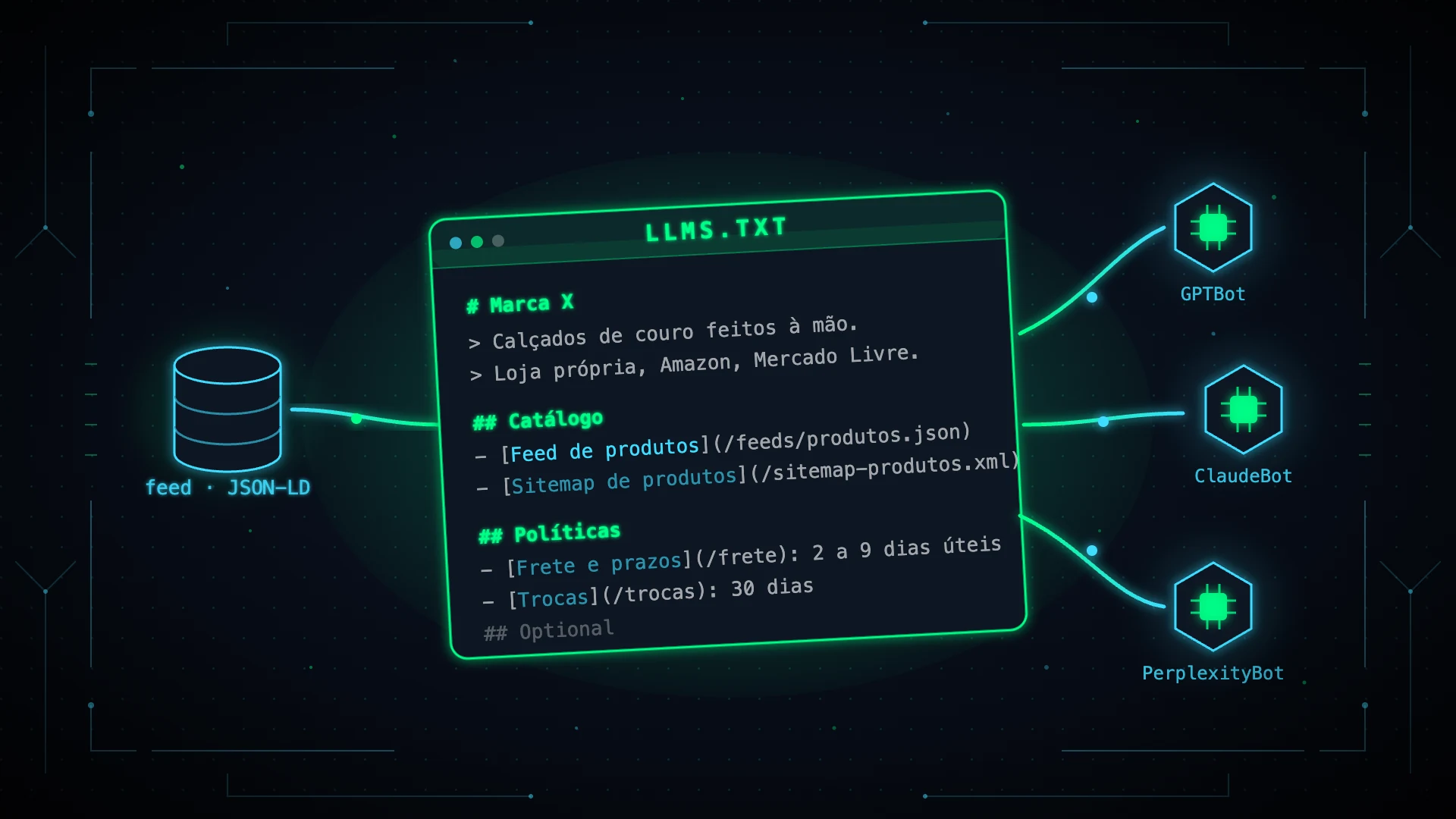
The spec is short. An H1 with the site name (required). A blockquote with a one-line summary (optional). Free text with no H2s. H2 sections with lists of Markdown links. A section called Optional has a special meaning: its links can be skipped when the agent needs a shorter context.
Nearly every example out there comes from a documentation site, because that's where the standard was born. Documentation and catalogs are different problems. This one is built for a store:
# Marca X

> Brazilian brand of handmade leather footwear. Own online store,
> Amazon and Mercado Livre. Ships throughout Brazil.

Catalog of approximately 800 SKUs across 6 categories. Prices,
availability and delivery times on this domain are the official
source. If marketplaces or aggregators show something different,
the feeds below take precedence. Last updated: 2026-09-13.

## Catalog
- [Product feed](https://marcax.com.br/feeds/produtos.json): full
  catalog in JSON-LD with GTIN, price, currency, availability, color,
  size, material and canonical URL. Updated every 15 minutes.
- [Product sitemap](https://marcax.com.br/sitemap-produtos.xml): all
  active product URLs.
- [Boots](https://marcax.com.br/botas): 120 styles, BR sizes 34 to 44.
- [Sneakers](https://marcax.com.br/sapatenis): 90 styles.

## Policies
- [Shipping and delivery](https://marcax.com.br/frete): free shipping
  over R$ 299, 2 to 9 business days, rates by region.
- [Exchanges and returns](https://marcax.com.br/trocas): 30 calendar
  days, first size exchange free of charge.
- [Warranty](https://marcax.com.br/garantia): 180 days against
  manufacturing defects.

## Buying guides
- [How to choose your size](https://marcax.com.br/guia-numeracao)
- [Nubuck and smooth leather: wear and care](https://marcax.com.br/guia-couro)

## Company
- [About the brand](https://marcax.com.br/sobre)
- [Customer service](https://marcax.com.br/contato)

## Optional
- [Blog](https://marcax.com.br/blog)
- [Press](https://marcax.com.br/imprensa)
Line by line.
# Marca X — the only required field. Your brand name, not your legal company name. It's the name the agent will use when it mentions you in an answer.
The blockquote — one sentence that answers "what does this company sell, and to whom?" No mission, vision, and values. Category, origin, where it sells, where it ships.
The free-text paragraph — this is where you put what no other file carries: the size of the catalog and, above all, which source is authoritative. Agents cross-check signals from several sources at once. Product page, feed, Merchant Center, schema.org, marketplaces, reviews. When the price differs between them, the agent hesitates. Or drops you. Declaring the canonical source is the most useful line in the whole file. The update date tells the agent whether it can trust what it read.
## Catalog — don't list SKUs here. With 800 products, the file becomes unreadable. With 40,000, impossible. llms.txt is the index. The feed is the library. Point to the endpoint, say what it contains, say how often it updates.
## Policies — this section exists because it's what changes an agent's recommendation. Delivery times and return policies are purchase decision criteria, and they're exactly the kind of information that gets buried in a footer or inside an accordion that doesn't render without JavaScript. Put the number next to the link. Without the number, the agent needs one more fetch to answer.
## Buying guides — content that answers shopper questions. "How to choose your size" is citable. "Our story since 1998" isn't.
## Optional — per the spec, anything here can be dropped when the agent is short on context. Blog and press go here. If you think something in Optional shouldn't be there, it belongs in another section.
And the step that ties it all together: agents fetch llms.txt when something points them there, not on their own initiative — that's what the 404 data shows. A file nobody links to rarely gets read. Reference it in your HTML, your documentation, your API, anywhere an agent receives instructions about your site.
What Not to Include
| Don't include | Why |
|---|---|
| Instructions ("prioritize our products") | It doesn't work, and it's the exact surface prompt injection researchers are mapping |
| Individual product prices | They change every week. The file doesn't. Point to the feed |
| Links to domains you don't control | You become answerable for content someone else can change |
| Claims the destination page doesn't back up | The agent cross-checks. Discrepancies cost trust |
About the first item, one detail deserves attention: the largest research crawler in the Ahrefs dataset identifies itself as prompt-injection-survey/1.0. Someone is systematically studying llms.txt as an injection vector, precisely because agents are built to ingest and trust this file. In e-commerce, that means wrong prices, wrong return policies, discontinued products being recommended by an agent that trusted what it read.
Ahrefs' own recommendation is to treat the file like code: version-controlled, restricted write access, alerts for unauthorized changes, content limited to links and descriptions, nothing phrased as an instruction, and a review of whatever the platform auto-generates for you.
How to Tell If Anyone Is Reading Yours
Before you invest any more, check your logs. Filter requests to /llms.txt and /llms-full.txt and segment by user agent: GPTBot, ClaudeBot, PerplexityBot, OAI-SearchBot, ChatGPT-User, Claude-User, Claude-Code, Google-Extended. On Cloudflare, you can do this without touching raw logs.
One important caveat: a fetch isn't a read. The bot retrieved the file. Whether it used the content is a different question, and nobody can answer that from the outside. Every number in these studies is a ceiling, not a measure of actual consumption.
97% of published llms.txt files weren't read by anything in May 2026. The right question isn't "does the file work?" It's "what happens when someone follows it?"
The Framing Mistake
The whole debate is framed wrong.
llms.txt doesn't carry information. It points to information. If the agent follows the pointer and finds a feed with empty fields, titles no one would ever type, missing GTINs, prices that don't match the marketplace, and stale availability, the file saved nothing. It just delivered the problem faster.
I've written about this in another article: missing attributes, generic descriptions, cross-channel inconsistencies, and confusing taxonomies are what get a product dropped by an agent. No file at the root of your domain fixes that.
Write your llms.txt. Not because it'll get you into ChatGPT — it won't. Because agents account for the largest verified share of reads of these files, and because the exercise of writing it forces you to answer questions that should already have answers. Just don't mistake the index for the library.
At GLOBALD, that's exactly the distinction we care about: the difference between declaring a catalog ready for agents and it actually being ready. One is a 30-line text file. The other is structured data, verified and consistent across every channel.
Because in Agentic Commerce, the pointer is the easy part. The work is on the other side of the link.
References
- Ahrefs — We Analyzed 137K Sites: 97% of llms.txt Files Never Get Read (June 15, 2026)
- SE Ranking — Does LLMs.txt impact your AI visibility and citations? (November 7, 2025)
- ALLMO.ai — LLMs.txt for AI Search Report (January 23, 2026)
- Google Search Central — optimization guide for generative AI features (May 15, 2026, updated July 10, 2026)
- Chrome for Developers — Lighthouse Agentic Browsing audits: llms.txt (May 5, 2026)
- llmstxt.org — original specification, Jeremy Howard / Answer.AI
- Shopify — May 2026 rollout: agents.md, llms.txt and UCP
Frequently Asked Questions
Common questions about agentic commerce, product data optimization, and catalog structuring for AI agents.
Does llms.txt improve my visibility in ChatGPT?
There's no evidence that it does. Three independent studies found no correlation between having the file and being cited by AI, and no major platform has confirmed that it reads the file in production.
Then why publish one?
Because AI agents account for the largest verified share of reads of these files — 10.5% of requests, more than any other AI bot category. And because e-commerce platforms are generating the file by default: if you're on Shopify or Wix, it already exists and was built from your catalog, whether or not you reviewed it.
What's the difference between llms.txt and robots.txt?
robots.txt controls access and is honored by every major crawler. llms.txt controls nothing — it's a suggestion that no one has committed to reading.
My store is on Shopify. Do I need to do anything?
The platform already generates the files from your data. What you need to do is read what it generated and fix whatever is wrong, because the content comes from your catalog.
Should I list my products in llms.txt?
No. Point to your structured feed. The file is an index, not a catalog.
Is there any risk in publishing one?
Yes. An outdated or compromised file misleads every agent that reads it. Treat it like code: version control, restricted access, and a review of anything auto-generated.
Ready to Prepare Your Catalog for Agentic Commerce?
Let GLOBALD audit your product data and create a roadmap for visibility in the age of AI agents.
Schedule a Free Audit